Bush Life

Sevilla, Spain 2010

“Bumba! You souljah?”

“Yeah, I was a soldier.”

“When I yout’ I went to military
school.”

“Really John? You were in the…”

“I was in the Navy. Ees fun, but ees
crazy. Ya know?

John was in the Jamaican Navy
and speaks in reggae verse. I’m not sure when he is speaking and when he is
singing. He’s smoking a porro, a hashish and tobacco spliff. The sun is
setting in Sevilla and the air is getting cold.

“I always be getting in trouble with
the ganja. Late, never on time. The Bossman, he always be saying, ‘Hey Rudeboy…
why you come late?’” John hands me the porro.

“Ees hard to be Rastafari ‘n the
Navy. Ees not easy wear helmet over dread.” John laughs as he palms his dreads.
“The helmet, you know, they always be falling off I head when I run. Hey
Souljah, you shivering. You want jacket?”

“No thanks, I’m not cold.”

“I see Souljah…Always I irie, always
I in trouble. They say, ‘Hey rude boy! Why you so irie eye?’ In Navy, you need
be there when Bossman say. But Rasta no say, ‘Need be here’,
Rasta no care.”

“Working for the Man.”

“Always I in trouble… sometimes we
guard ship.” John gestures at a passing ship on the Guadalquivir river. “Why we
guard ship? Why this ship! Isn’t no one on ship. Why you tell me to guard ship?
You guard ship!”

“No one likes guard.”

“So we sleep, the Bossman, he sleep.
When Bossman no sleep he catch us, ‘Hey boy… do ten pushup.’”

“That’s his way.”

“Why I do ten pushup? You sleeping,
I sleeping. I no slave, youse big man, youse in charge. I know. Youse lion,
O.K. Why make me do pushup? It no prove nothing”

I can only nod.

“Ees crazy. Ees fun, but ees crazy”

An icy wind comes off the river.
Time for me to go.

“I miss it. ” John takes a final
drag of the porro, “I miss the bush life. Ees simple, ees hard, but ees
fun. It make a Rasta feel like a real lion. You know?” John flicks the roach
into the river.

A real lion, I miss that feeling.

“I love bush life. If no discover
Rastafari, no discover Jah I may still be Navy. But Jah no about taking life.
Jah no like Bossman tell what do. Rastafari ees simple, ees love. Rastafari, it
save me… you cold Souljah, why you no put jacket on?”

“I’m not cold.”

“Ees fun, but ees crazy. The bush
life. I miss it.”

Everyday.

“Lion be home in the bush.”

Always.

Sober Sleepless Nights

It seems like forever since I’ve had a good night’s
sleep. I stay up at all hours of the night alone and read book after book after
book. My tears well up and I am crying as I read about war. I miss being a
warrior. I read books about Vietnam and think, “I didn’t have it so bad.” And
deep down I wish I did. It all seems so far away and yet it’s all I can think
about.

I can’t be around people. There’s nothing in common.
They don’t like me, it’s plain to see, why are they even pretending. I see
pretty girls and see openings to talk to them. I don’t. It’s not that I’m
scared, I just don’t care. I know nothing will happen. I don’t want to invest
the time. I’d rather be alone.

Alone and I miss people. But there are no people. I
talked to Hunter today, he sounds happy again and I’m glad. He had another baby
girl. We laughed as he talked about ‘Hell House’. He wants to go back to Iraq
one day. Tourist visit, we’ll sleep in the IRAM holes. I do too.

Crushing solititude. I didn’t leave the apartment
all day today. Besides the phone call with Hunter I didn’t utter a single word.
I thought about how easy this was.

I sent Facebook messages to one hundred and
fifty people I grew up with. I went to school with these people. Along the way
I picked up and lost friends, not too many with bad feelings. Mostly we drifted
away and life moved on. Schoolboy crushes, smoking partners, acquaintences, legends,

nerds, jocks, people I sat next to in elementary school, people who attended my
parties in high school. I sent out one hundred and fifty messages. I asked how
they were, I asked them to check out the book. One hundred and fifty, maybe
twenty responded.

They said, congratulations. They said they’d check
it out. They said they’d buy it. Why do people say things they’re not going to
do? At least that twenty didn’t ignore me. One hundred and fifty people, not
one new reader. Not one.

I have too much faith in people, somehow this surprised
me. It shouldn’t have. I’ll see many of these people in the next few years.
Home is a small place indeed. The guys will probably shake or slap my hand,
some of the girls may hug me. I should refuse, but I won’t. I’ll smile and nod
my head and say it was great to see you.

Terrible and crushing loneliness. I’ve given up
smoking and embraced reality again. It’s hard to deal with the existential
pain, but I know it’s good for me. I go to school and get inspired and speak
out and stutter and then I am ashamed. Even when I don’t stutter the others
make me shamed at enthusiasm, at passion, and knowledge. I’m a good student this
semester. Nothing but time.

I remember not being able to sleep at Warhorse, at
KBS, in Baghdad. This was a reflective sleeplessness, an exuberance, an energy.
I embraced the loneliness then, only rarely was it painful. I had too many
brothers around. Too many, now there are none.

Holding here in Hawaii. I’m sick of being a haole
and seeing the hate in people’s eyes. I’ve done nothing to offend them. They hate
because I’m big and strong and confident and bright. So much hating because of
this. Hatred because I’m awake. Hatred because I cannot sleep.

And itching. Residual itching from the bed bugs from
New Orleans. The worst part is, I don’t know if they’ll be waiting for me back
home. Maybe they’re here. So much to do and yet nothing to do.

Five years as a warrior. Two years in the desert
wasteland. One year in my writer’s cave. Two months on the road. Now all the
energy is gone. Idealism is dead and I confront failure. You didn’t send me
letters in Iraq. You didn’t buy a drink when I made it home. I bought the
drinks. I sent out the letters. I read alone. I read about war and about
warriors and I am crying.

Sober sleepness nights. And I dream of war.

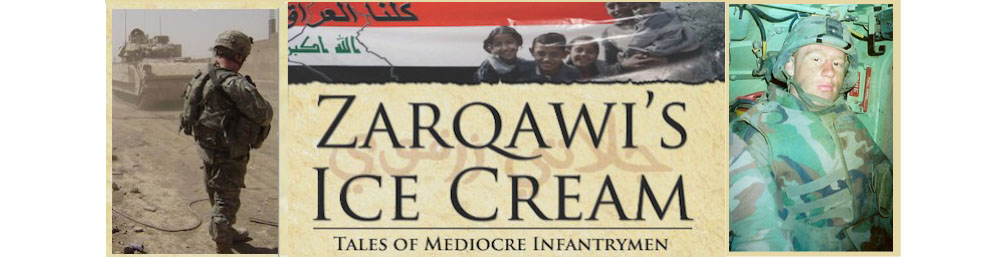
“Zarqawi’s Ice Cream”: One Vet’s Tales on His Time in Iraq

From Associated Content…

‘Zarqawi’s Ice Cream’: One Vet’s Tales on His Time in Iraq

Andrew Goldsmith Relives the Iraq War

By Amy and Nancy Harrington, Pop Culture PassionistasYahoo! Contributor Network

May 6, 2011

In 2004, 19-year-old Andrew Goldsmith was bored. So he did what any red-blooded American boy would do. He joined the Army. He served two tours in Iraq — the first in 2006 and the second in 2008. He climbed the ranks from private to sergeant and then left the military in 2009. He’s now written a book about his experiences. “Zarqawi’s Ice Cream” is a personal account about the effects of modern day war and his changed perception of the world.

In a recent interview, Goldsmith revealed that he thought joining the army would be “a little bit more action, more combat, a little more danger, more romance.” But that is not what he experienced. He divulged, “There was that element of danger and bravery and explosions, but like anything in life it tends to be 90% drudgery for all the excitement and danger that you face — a lot of hard work, a lot of bureaucracy, a lot of menial labor. That’s kind of the source of a lot of my stories is that aspect of the un-military life, that aspect of the Iraq life. And I don’t think it’s covered in too many other places, but it’s a very important part of it.”

Goldsmith said the title, “Zarqawi’s Ice Cream,” came from one of the signature stories in the book, which took place during his first tour of duty in 2006. He explained, “It’s basically the mission that we all thought would be super cool, super cool infantry mission, but it ended up being a worse mission than some of the worst ones we’ve ever been on. I guess it’s a story of irony, twist of fate.”

Goldsmith described his time in Iraq, saying, “The impact made me less of an idealist, more of a realist. I saw that things in the real world are never black and white. It’s always shade of grey. No one’s ever wholly evil. No one’s ever wholly good. We all have our personal battles. And I’m just really glad I was able to get the perspective on the world and on the way it actually is by going to another country, a war torn country like Iraq and it’s really helped me understand my own country and my own people a little bit better as well.”

The veteran came back home with a new point of view, but was challenged by how to fit in to this now mundane, every day life. He started college in Hawaii and began to attempt reintegration. His biggest difficulty was finding commonalities with civilians, admitting, “Sometimes I have this alienation, this feeling that we don’t really have any shared experiences, any common history. So that’s been a big problem.” He added, “I don’t have any major PTSD events. Loud explosions don’t really spook me too much. They do sometimes but I deserve it, it means I’ve been staying up too late or something. But that’s about the extent of it. I think it’s mostly just social relationships, finding friends again. Trust is an issue a lot.”

Trying to find his way, Goldsmith spent a semester abroad in Europe — a period that would open the floodgates for the first-time author. He recalled, “That’s were the creative tendencies of this book really happened. That’s when I was reliving a lot of this stuff. The stories just kept coming into my head and that’s when I first stared writing it down and the idea for a book gradually formed.”

He noted, “This whole writing project was not something I really wanted to do… it’s always been something that I have to do. Something has been compelling me to write this. Whether that’s for catharsis, peace of mind. Whether it’s just that when we tell our stories, it lets us live with who we are, what we’ve done.”

And so “Zarqawi’s Ice Cream” was born. Goldsmith admits there is content that non-military readers may not relate to, but he also pointed out, “It’s for anybody. It’s for my mother, my father. But there’s some hidden stuff that Iraqi veterans, Afghanistan veterans, are really going to like. They’re really going to understand more than anybody.”

He has shown the book to some of his war buddies from Iraq and remarked, “They’ve all loved it. Positive responses.” He got a lot of support from his fellow vets during the process of writing the book.

“When this project was in its early stages, my ego wasn’t too built up yet, and I wasn’t really confident in my work. Whenever [the editors] would redo it and [my friends would] respond positively to it, that would give me a little more impetus to keep going, check it out.”

After he finishes his current semester at school, Goldsmith will embark on a two-month cross-country tour to promote the book. He’ll be traveling with Bob Harrington, an army buddy who has started a charity called AspiringWarrior.org to raise money for higher education scholarships for vets. The duo will stop at military bases, bookstores and country fairs. Goldsmith stated, “It’s going to be a mixture of selling books out of the trunk of the car and professional PR work.”

After the tour, the author will return to school but hopes to pen another work. He reflected, “This process of writing has been awesome. It’s been real natural. So I definitely see some more in the future.”

For now he hopes people walk away from reading this book with a new understanding of the military. He commented, “First off, they’re going to like the story. It’s a great story. Secondly, they get to follow the hero in a modern era. This is how our generation goes to war. So anybody who wants to experience that is going to enjoy this book. This book is going to enlighten a lot of people as to how war is these days. What it does to people, the consequences of it. Who the enemy is… It’s good stories. Everyone’s going to laugh. There are some parts where you’re going to want to cry.”

“Zarqawi’s Ice Cream” goes on sale in May 2011.

Iraq War Stories: A Catharsis

Welcome.

I began to write Zarqawi’s Ice Cream shortly after leaving the army…not because I wanted to, but because I had to. The process hasn’t been easy. Recalling these tales has ensured that my head remained in that world long after returning to civilian life. Is it possible to ever fully reintegrate into civilian life after two tours in Iraq? Maybe not. Nonetheless, purging these war stories from my mind and onto paper has been a much-needed catharsis to putting the past behind me. Those who have served will understand; those who haven’t might not.

The following is a passage from Chapter One: Call to Adventure. Names have been changed to protect the innocent and the guilty.

…………………………………………………………………………………………………………………

“Goldsmith, tell me a story about Iraq.”

“What kind of story do you want to hear?”

“I dunno, a good story.”

“You want a funny story? A sad story? A war story with a lot of action?”

“Any story—your best one.”

My best story—that’s asking a lot. Should I talk about the IRAM attack or Ranger School? Should I depict the nobility of Moneyshot or relive the guilt of blowing that poor lady’s finger off? If I had to tell one story, one epic tale to sum up years of debasement and triumph, of groveling servitude and absolute power, of stagnation and explosive growth, what would it be?

“How about ‘Zarqawi’s Ice Cream’?” I say. “So late one night we—”

“Wait! Zarqawi? Wasn’t he a terrorist or something?”

“Oh, yeah! The evilest guy in Iraq, and that’s saying something. So then the ramp drops and—”

“Did I ever tell you my friend’s sister’s fiancé is going to Afghanistan next week? He’s in the Air Force.”

Nobody likes a war story. It won’t get you laid, convince the cop to give you a warning, or get you a free pint at the bar. The veteran gets excited telling his epic tale. He expects acknowledgment, understanding, love, or something deeper. All he gets is a vacant stare, an abrupt and nervous change of subject, or no response at all. Sometimes his listeners are horrified. This guy’s a monster! He can read it on their faces. Acts of heroism, cowardice, and senseless butchery are seared into a soldier for eternity. Entire lives can revolve endlessly around a single commendable or odious event. Truly lost soldiers are forever in search of the great war story.

“. . . And then Scooter says, ‘How’s it smell, bitch?’”

“Yeah? And then what?”

“That’s it. That’s the end of the story.”

“I don’t get it—why would he do that?”

“The bullets, the explosions . . . they messed with his head.”

“Oh.”

“See, we were all under a lot of stress, and . . . guess you had to be there.”

These tales provide a glimpse into the life of an infantryman, into an existence that is extraordinary yet mediocre—a world most people will never live in or understand. Warning: it is a masculine world devoid of feminine sentiment and solace. It is also a bigoted world, charged with the irrational hatreds of combat. The infantry life is schizophrenic: withering heat and biting cold, sloth and inhuman exertion, exultation and shame. The infantryman loves and hates his life with equal passion, and he is never far from death. There is unique pride in the struggle that forms the core of the infantry experience, boundless love in the brotherhoods cemented in the wilderness.

“Who do you think is the best unit?”

“I don’t know: Rangers, Eighty-second Airborne, maybe Tenth Mountain.”

“You know who I think is the best unit?”
“Who’s that?”

“The men I went to war with.”

The men in these war stories didn’t capture the world’s most wanted terrorist, get in any major battles, or wade waist deep through the enemy dead. They were never seriously wounded, didn’t storm any machine gun nests or win any flashy medals. By anyone’s standards, we were mediocre infantrymen. So what did we do? We managed to survive some of the harshest conditions on earth, suffered bouts of insanity, and weathered the assaults of our enemies. We did what our country asked of us, stayed faithful to each other, and came home again. And through it all, we never lost our humanity.

Were heroic deeds done? Absolutely. Are there heroes in this story? Certainly not. We are your sons and your soldiers. These are our stories.